Every major tournament, the same pattern plays out. Brands get swept up in the excitement, campaigns go live, and somewhere down the line a letter arrives demanding they pull content they spent months and serious money producing. No logos used. No official partnership claimed. Just a reference to the World Cup. And yet, legally, that was enough.
When a global organisation like FIFA puts on a tournament of this scale, they don't just organise football matches. They build and register an enormous legal framework around the entire event, covering the name, the imagery, the slogans, the mascots and certain phrases associated with it. Companies that pay hundreds of millions to become official sponsors are buying access to that framework. Everyone else is, legally speaking, on the outside.
The 2026 World Cup will be the biggest edition of the tournament in history. More teams, more matches, more fans, and more brands trying to reach those fans. This also means more risk for the businesses that haven't thought this through carefully.
To understand why, it helps to know the history behind the relationship between intellectual property and sports.
A century of sports trademarks: from pitch to portfolio
Sports and intellectual property have always been intertwined, but the relationship has grown dramatically more sophisticated over the past hundred years.
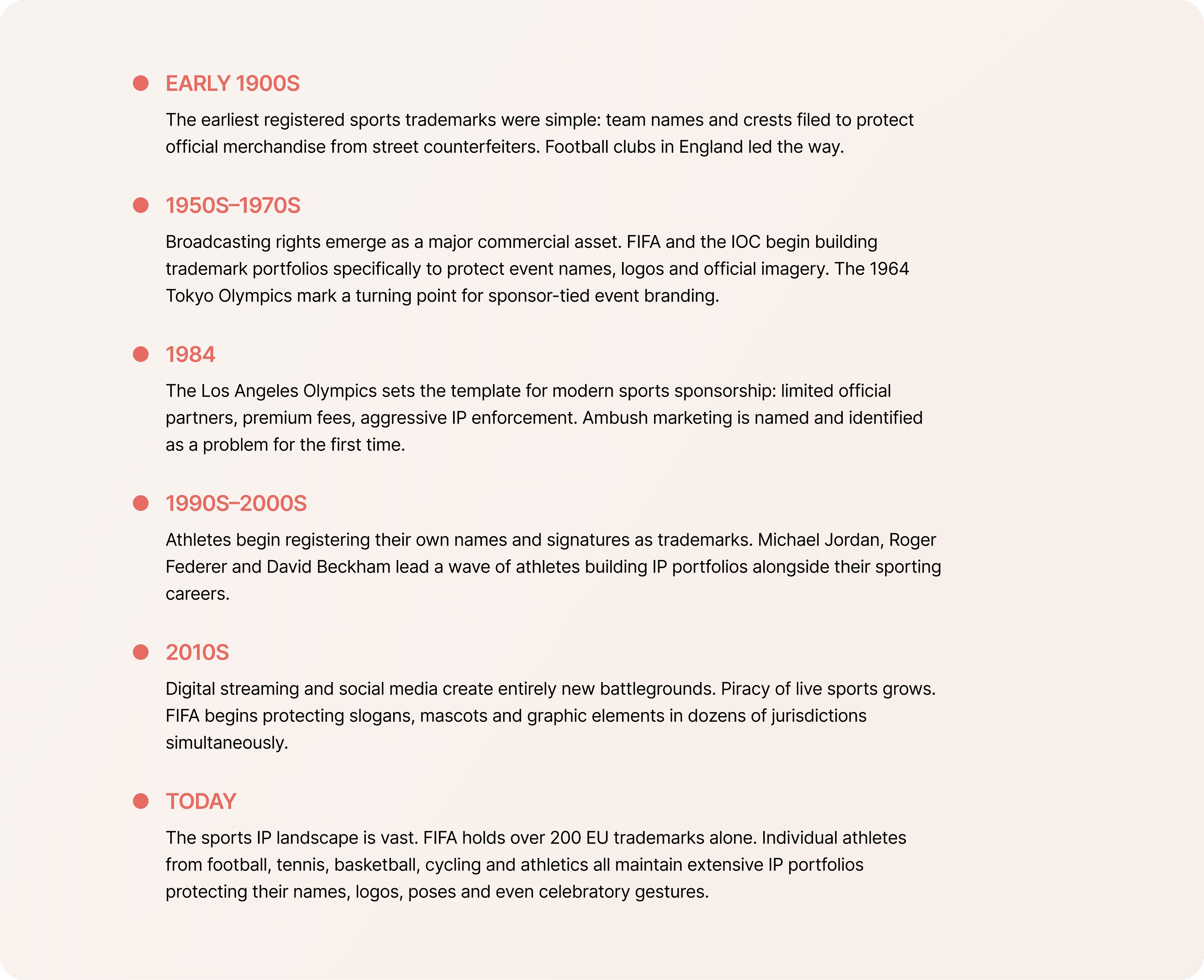
Today, the intellectual property of sports extends far beyond logos. EU trademark registrations in sports now cover mascots, trophies, team colours, badges, promotional materials, distinctive chants (Liverpool FC's "You'll Never Walk Alone") and signature sounds associated with clubs.
That expanding portfolio of rights serves a specific function. The growing commercial value of sports IP has made it an increasingly attractive target for counterfeiters and pirates. According to EUIPO estimates, sales of fake sports equipment alone cost the EU €851 million annually, equivalent to 11% of total sector sales. For rights holders, protecting IP in sport has become as much about enforcement as registration.
The World Cup as a global brand, not just a tournament
For FIFA, the World Cup is not simply a football competition. It is the centrepiece of a commercial enterprise that spans media rights, marketing, licensing, ticketing and sponsorship. FIFA exists to protect that enterprise just as fiercely as any consumer goods company protects its product brands.
Unlike the Olympic Games, which benefit from dedicated legal protection in certain countries (Germany, for instance, has a specific Act on the Protection of the Olympic Emblem and Olympic Names), the World Cup has no equivalent special legislation in Europe or the host countries. What FIFA does have, however, is an enormous international trademark portfolio and the resources to enforce it.
The scope of that portfolio often surprises businesses. FIFA's trademark registrations cover not just obvious categories like sportswear or broadcasting, but also food and drink, financial services, musical instruments and means of transport. If your company operates in almost any consumer-facing sector, FIFA likely holds a trademark in your space.
Why this matters for your business
FIFA’s trademarks are registered across numerous classes of goods and services, including many that businesses would never associate with football. Before using any World Cup-related term or imagery in your advertising, assume FIFA has a relevant registration and check accordingly.
What FIFA has actually protected for 2026 and 2027
For its two upcoming tournaments, FIFA has already registered or is actively seeking registration for a specific set of signs. These "Official Marks" are exclusively available to FIFA and its official partners.
FIFA Protected signs: 2026 & 2027 Tournaments |
|---|
The official logo “26” |
Official slogans: “WE ARE 26,” “SOMOS 26,” “NOUS SOMMES 26” |
Tournament mascots: Clutch the Bald Eagle, Maple the Mosse, Zayu the Jaguar |
The official logo “BRAZIL 2027” and “GO EPIC” |
The FIFA World Cup trophy design |
This is not an exhaustive list. FIFA regularly adds to its portfolio as tournaments approach, and Official Guidelines have already been published for 2026. Any business planning campaign materials should consult those guidelines directly.
Ambush marketing: the "red card" businesses fear
The term "ambush marketing" describes a strategy where a brand, without paying for official sponsorship, associates itself with a major event in the public mind. It is a practice FIFA takes extremely seriously, and its track record of enforcement goes back decades.
The most-cited example remains the 2010 World Cup in South Africa, where a group of women were ejected from a stadium and faced legal proceedings simply for wearing orange dresses associated with the Bavaria beer brand. No logos were visible. The stunt was enough: FIFA's position was that any covert promotion that undermined official sponsors could be pursued as ambush marketing.
There are broadly three types of ambush marketing FIFA monitors:
Direct ambush: using a protected term, logo or sign without authorisation
Association: implying a sponsorship or partnership relationship with FIFA or the tournament
Intrusion: advertising within the physical or media environment of matches without a licence
FIFA can pursue claims for trademark infringement, unfair competition and false designation of origin. A single ad can expose a company to simultaneous claims from FIFA and from individual players.
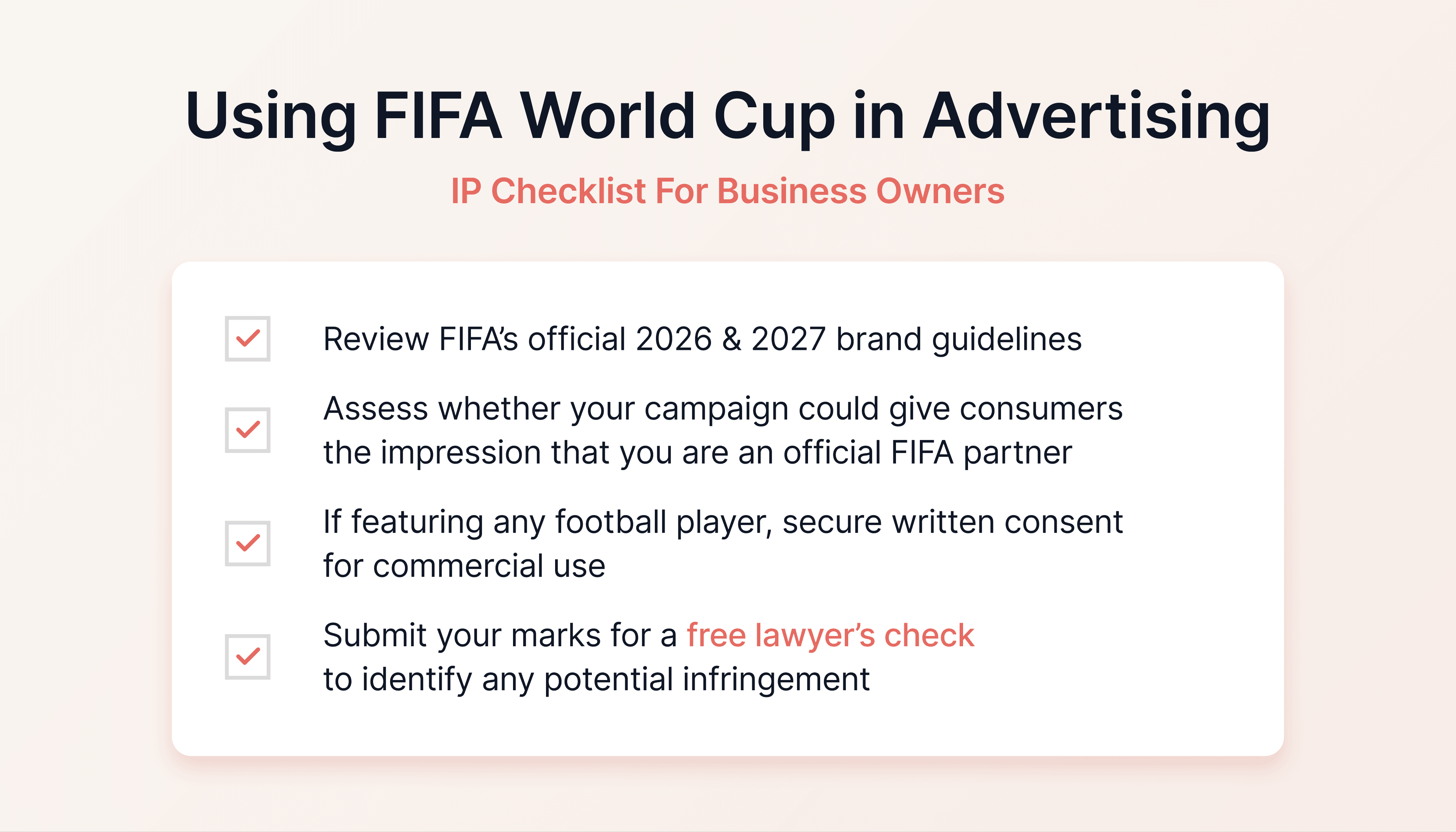
The cost of getting World Cup advertising wrong (injunctions, damages, public litigation) significantly outweighs the cost of getting it reviewed properly in advance. Here is a practical checklist for businesses planning any World Cup-related campaign activity:
The bottom line for businesses and fans alike
The 2026 FIFA World Cup will be one of the most commercially significant sporting events in history, and one of the most legally complex environments in which to advertise. The rules are not designed to prevent businesses from celebrating the tournament or reaching fans excited about the game. They are designed to prevent companies from free-riding on FIFA's investment and misleading the public about sponsorship relationships.
For businesses, the path forward is clear: celebrate the football, reference the event factually, create original content and get professional advice before anything that looks like official affiliation. The World Cup is big enough to share, within the rules of the game.